

How Do They Clean Flexable Aie Ducts
When it's a hot summer day outside, but a brisk 68 degrees in your home, yous might find yourself wondering, "How practice air conditioners work?" To sum it up, air conditioners remove heat and humidity from the air within and identify it outside to ultimately absurd down your abode.
To complete this procedure, a lot of dissimilar parts of the air conditioner need to piece of work together. And let'due south non forget that in that location are multiple types of systems that all fulfill the same goal of cooling your dwelling. Let's dive into the specifics, so you can empathise how your air conditioner really works and discover which organisation is right for y'all.
How AC works: Primal air and split systems
Generally speaking, there are two categories of air conditioners: cardinal cooling systems and ductless split systems. While both work to cool your home, these systems function in vastly different means.
Central cooling systems
Central air conditioners are designed to cool your entire home. To do this, they distribute cool air through the ducts in your habitation, so the air reaches every single room. Central air conditioners have one outdoor portion and one indoor portion that are connected past copper tubes, unless it'southward a packaged unit of measurement which is located completely exterior the home.
Because central cooling systems cool entire homes, the units take upward more space than ductless systems (nosotros'll get to those in a 2d!). The smallest possible size for a central air conditioner is 1.5 tons. These kinds of units can achieve up to 22 SEER, or Seasonal Energy Efficiency Ratio, which is a measure of how energy efficient an air conditioner is during the spring and summer months. Minimum SEER ratings in the Us are at least 14, according to the Section of Energy, then while primal AC tin cool your entire home, they're not always the most energy-efficient option and tin come with high energy costs.
Ductless split systems
Ductless systems are meant to cool simply one room or portion of your domicile, rather than the entire business firm. Ductless systems are inherently dissimilar from central cooling systems because the air flows through indoor units into private rooms instead of ducts throughout the house. Ductless systems besides have an indoor and outdoor component, but unlike central cooling systems, this is not a i:i ratio. Instead, ductless systems tin can have up to five indoor units for every one outdoor unit. This means up to five units can exist installed throughout a home to cool upwards to five rooms without the presence of ducts.
When the ductless outdoor to indoor ratio is ane:1, it's called a mini-split. When the ratio is any more than 1:one, it'south referred to every bit a multi-split. Because these units are designed to cool smaller spaces, they come up in a minor size, with the smallest being .75 tons. Ductless split systems can achieve up to 33 SEER, making them a much more energy-efficient option than central cooling systems. Using them will likely save yous money on your energy bill despite their higher initial costs.
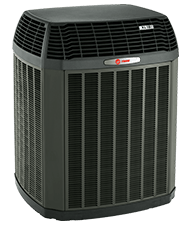
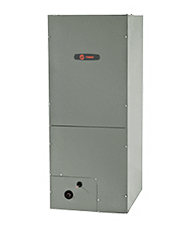
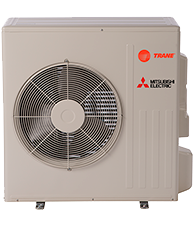
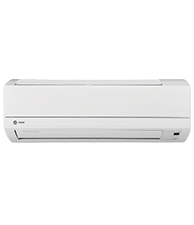
Here, the top two images feature examples of fundamental cooling systems, and the bottom two images feature examples of ductless systems.
Air conditioner types
Understanding the different types of air conditioners will help y'all determine which is right for your home.
Central air conditioner
As we mentioned to a higher place, fundamental heating and cooling systems, like central air conditioners, work by feeding air via ductwork through your abode. Central air conditioners have both an indoor unit and an outdoor unit, and are 1 of the most common types of air conditioners. These units are great for homes with a basement or crawlspace because the indoor portion can exist tucked away in an unused space.
Packaged air conditioner
Packaged air conditioners are some other type of central air conditioner. Packaged systems are unique considering they provide air to the entire home, but don't characteristic a 1:one indoor to outdoor unit of measurement dissever. Instead, packaged systems are 2 in one and are just located outside the home. These units are great for homeowners who want primal air workout, simply have nowhere to shop a large indoor unit in their domicile.
Dual fuel organization
Dual fuel systems are a i-stop-shop for all your heating and cooling needs. A dual fuel system doesn't apply an air conditioner, but instead is fabricated up of a heat pump and a furnace, with the oestrus pump doing the cooling during the leap and summer months. A estrus pump can both oestrus and cool, and then in a dual fuel system it can switch between functions depending on which is needed. Dual fuel systems function best in mild to extremely cold climates, and then if you live in a place with irresolute temperatures, a dual fuel system could be the right fit for yous.
Ductless mini-split
Ductless mini-splits are perfect for those who need to absurd only one room. In the case of a ductless mini-split, there is one outdoor unit connected to 1 indoor unit, and all of the cooled air will be pumped into the single room where the indoor unit is located. Ductless mini-splits work cracking for people living in their own sleeping room with other roommates in the rest of the abode, like college students.
Ductless units can exist mounted on the floor or the wall. Wall-mounted air conditioners are normally installed college up, and so it takes longer to feel the effects of the cool air, just they're better at evenly distributing air. Flooring-mounted ACs make you experience the cool air quicker and they look more unimposing, but airflow tin can be compromised.
Ductless multi-split up
A ductless multi-split works the same as a ductless mini-split, except the outdoor to indoor unit of measurement ratio tin can get upward to 1:5, meaning up to five rooms can be cooled without ducts. Ductless multi-splits are expensive to install initially because they require purchasing upward to five individual ductless units. Only, they are more free energy efficient and price less in utility bills compared to central cooling. Ductless multi-splits are platonic for people who live in homes without ductwork or those looking to relieve on their energy bills in the long run.
Window air conditioner
Window air conditioners are true to their proper name — they're air conditioners installed in the window of your domicile. These air conditioners work in a like way to ductless AC units in that they cool a single room in your home. Just, they're installed in a like style to central Ac units in that they're typically one-half inside and half outside. Window air conditioners tin exist noisy and unappealing to look at, but they're inexpensive to install and maintain.
Air conditioner components
Now that y'all know about all the dissimilar types of air conditioners, permit's look at the major parts that brand them up.
Thermostat
All air conditioners are controlled by a thermostat that sends signals to the HVAC system when it's fourth dimension to get-go cooling. There are ii different types of thermostats: electronic and electromechanical. Electronic thermostats have sensors that read the temperature while electromechanical thermostats take metal strips and mercury that tip off the air conditioner that information technology's fourth dimension to cool.
Refrigerant
Refrigerant is an essential part of an air conditioner — without it the entire arrangement wouldn't be able to function. This chemic cooling compound flows throughout the air conditioner, arresting and releasing heat at unlike stages to cool downward your dwelling. The cooling process kicks off when a fan blows heated air from inside your home into the air conditioner, and the refrigerant absorbs that heat within the evaporator roll.
Evaporator coil
The evaporator coil is the identify for absorbing oestrus. When the fan blows hot air from your habitation over the common cold evaporator coils, the cool liquid refrigerant inside absorbs the heat from the air completely, then continues on through the air conditioner.
Compressor
After the refrigerant absorbs heat in the evaporator coil, it goes to the compressor. The compressor increases the pressure level of the at present-hot refrigerant, which increases its temperature even more and then that information technology's hotter than the temperature outside. While in the compressor, the refrigerant turns into a gas. Once the gaseous refrigerant is hotter than the outdoor climate, it can dispense heat outside.
Condenser curlicue
The condenser coil receives that hot, pressurized gaseous refrigerant from the compressor. The condenser coil is designed to release the heat the refrigerant is carrying outside. This cools the refrigerant down and turns it back into a liquid, ready to absorb more rut from your home.
Expansion valve
When the refrigerant leaves the condenser coil, even though information technology releases about of its oestrus outside, information technology's still too hot to re-enter the evaporator coil. And then, the expansion valve works past decreasing the pressure of the refrigerant and cooling information technology back downward even more. The expansion valve sends the cold refrigerant back into the evaporator gyre, where it picks up more rut from the air within your domicile and the process repeats itself.
Air-conditioning FAQs
How does central air work?
Key air-conditioning works past moving around air in your home until it reaches your desired temperature. Central air systems pull hot air from your home, work to cool information technology downward by releasing its heat outside, then distribute the newly-cooled air through a system of ducts in your home. That manner, every room is reaching the ideal temperature.
How does ductless air conditioning work?
Ductless air conditioners work to cool only one room at a fourth dimension. Unlike fundamental air conditioning, which cools your entire home via a system of ducts, ductless air-conditioning direct releases cool air into a single room. Equally we mentioned earlier, ductless systems require one outdoor unit and at to the lowest degree one indoor unit. If you want to cool more than just one room but still use ductless air-conditioning, you can install up to five indoor units that will all piece of work at the same time together with the singular outdoor unit.
Does an air conditioner take in air from the outside?
No. Air conditioners take heat and humidity out of the air inside your dwelling house, then distribute that heat and humidity outside while returning the newly cooled air back to the house. Air conditioners never take air from outside and put it in your home. Instead, they work by cooling downwards the air that's already in your home.
Can an air conditioner ameliorate indoor air quality?
Air conditioners can improve air quality. Afterwards heat and humidity are absorbed from the air inside your home, the air is filtered for grit, lint, and debris. The heat gets moved outside, but the air that remains and goes back into your dwelling house is cleaner than before, resulting in better air quality.

Source: https://www.trane.com/residential/en/resources/hvac-basics/how-does-an-air-conditioner-work/
Posted by: cuomofrapter69.blogspot.com
0 Response to "How Do They Clean Flexable Aie Ducts"
Post a Comment