

Is Dawn Best For Cleaning Oil Spills Science Fair Project
Summary
This hands-on experiment provides students with an understanding of the issues that environment ecology cleanup. Student teams create their own oil spills, try different methods for cleaning them up, and and then discuss the merits of each method in terms of effectiveness (cleanliness) and cost. They are asked to put themselves in the place of both ecology engineers and oil company owners who are responsible for the cleanup.This applied science curriculum aligns to Side by side Generation Science Standards (NGSS).
Applied science Connexion
Environmental engineers are called upon to assist with the cleanup of oil spills and other environmental hazards. They must be familiar with different cleanup methods and so effectively communicate these strategies with the community, the cleanup coiffure and the company/person responsible for the spill. Environmental engineers' contributions to environmental cleanup are important in keeping our Earth'southward h2o and land salubrious for plans and animals.
Learning Objectives
After this action, students should exist able to:
- Identify some causes and furnishings of oil spills on a h2o source and the organisms that employ that water.
- Describe the dissimilar methods that environmental engineers apply to clean upward water pollution.
- Use volume to describe the amount of oil and h2o removed during the model cleanup.
- Organize their oil removal data and analyze using a bar graph.
Educational Standards Each TeachEngineering lesson or activity is correlated to one or more than K-12 science, technology, engineering or math (STEM) educational standards.
All 100,000+ K-12 Stalk standards covered in TeachEngineering are nerveless, maintained and packaged by the Achievement Standards Network (ASN), a project of D2L (www.achievementstandards.org).
In the ASN, standards are hierarchically structured: first by source; e.m., by state; within source by type; e.m., scientific discipline or mathematics; within type by subtype, then by grade, etc.
Each TeachEngineering lesson or activity is correlated to one or more than K-12 science, technology, engineering or math (STEM) educational standards.
All 100,000+ K-12 Stalk standards covered in TeachEngineering are nerveless, maintained and packaged by the Achievement Standards Network (ASN), a project of D2L (www.achievementstandards.org).
In the ASN, standards are hierarchically structured: first by source; e.m., by state; within source by type; e.m., scientific discipline or mathematics; within type by subtype, then by grade, etc.
NGSS: Side by side Generation Science Standards - Scientific discipline
| NGSS Performance Expectation | ||
|---|---|---|
| MS-ESS3-3. Use scientific principles to design a method for monitoring and minimizing a human impact on the environs. (Grades vi - 8) Do yous agree with this alignment? Cheers for your feedback! | ||
| Click to view other curriculum aligned to this Performance Expectation | ||
| This activity focuses on the following 3 Dimensional Learning aspects of NGSS: | ||
| Science & Engineering Practices | Disciplinary Cadre Ideas | Crosscutting Concepts |
| Apply scientific principles to design an object, tool, process or system. Alignment agreement: Thanks for your feedback! | Human activities take significantly altered the biosphere, sometimes dissentious or destroying natural habitats and causing the extinction of other species. But changes to Earth's environments tin have different impacts (negative and positive) for dissimilar living things. Alignment agreement: Thanks for your feedback! | Relationships can be classified equally causal or correlational, and correlation does not necessarily imply causation. Alignment understanding: Thanks for your feedback! The uses of technologies and any limitations on their apply are driven by individual or societal needs, desires, and values; past the findings of scientific research; and by differences in such factors as climate, natural resource, and economic conditions. Thus technology use varies from region to region and over time.Alignment understanding: Thanks for your feedback! |
| NGSS Operation Expectation | ||
|---|---|---|
| MS-ETS1-2. Evaluate competing blueprint solutions using a systematic process to determine how well they run across the criteria and constraints of the problem. (Grades 6 - 8) Practice you agree with this alignment? Thanks for your feedback! | ||
| Click to view other curriculum aligned to this Performance Expectation | ||
| This activity focuses on the following 3 Dimensional Learning aspects of NGSS: | ||
| Science & Engineering Practices | Disciplinary Core Ideas | Crosscutting Concepts |
| Evaluate competing pattern solutions based on jointly developed and agreed-upon design criteria. Alignment agreement: Thanks for your feedback! | There are systematic processes for evaluating solutions with respect to how well they meet the criteria and constraints of a trouble. Alignment understanding: Thanks for your feedback! | |
| NGSS Operation Expectation | ||
|---|---|---|
| MS-ETS1-iii. Analyze data from tests to decide similarities and differences among several design solutions to identify the best characteristics of each that can exist combined into a new solution to better meet the criteria for success. (Grades 6 - viii) Do y'all hold with this alignment? Thanks for your feedback! | ||
| Click to view other curriculum aligned to this Performance Expectation | ||
| This activity focuses on the following 3 Dimensional Learning aspects of NGSS: | ||
| Science & Applied science Practices | Disciplinary Cadre Ideas | Crosscutting Concepts |
| Analyze and interpret data to determine similarities and differences in findings. Alignment agreement: Thanks for your feedback! | There are systematic processes for evaluating solutions with respect to how well they come across the criteria and constraints of a problem. Alignment understanding: Thanks for your feedback! Sometimes parts of different solutions can be combined to create a solution that is better than any of its predecessors.Alignment agreement: Thanks for your feedback! Although ane design may not perform the best across all tests, identifying the characteristics of the design that performed the best in each test can provide useful information for the redesign process—that is, some of the characteristics may be incorporated into the new design.Alignment agreement: Thanks for your feedback! | |
Common Core State Standards - Math
- Find a per centum of a quantity equally a rate per 100 (e.g., thirty% of a quantity means thirty/100 times the quantity); solve bug involving finding the whole, given a role and the percent. (Form vi) More Details
View aligned curriculum
Do you lot agree with this alignment? Thanks for your feedback!
- Display numerical data in plots on a number line, including dot plots, histograms, and box plots. (Grade half-dozen) More Details
View aligned curriculum
Do yous agree with this alignment? Thank you for your feedback!
- Use ratio and charge per unit reasoning to solve real-earth and mathematical problems, e.g., by reasoning about tables of equivalent ratios, tape diagrams, double number line diagrams, or equations. (Course 6) More than Details
View aligned curriculum
Practice yous concur with this alignment? Thank you for your feedback!
International Technology and Engineering science Educators Association - Technology
- The direction of waste produced by technological systems is an important societal issue. (Grades 6 - 8) More Details
View aligned curriculum
Practise you lot hold with this alignment? Thanks for your feedback!
- Technologies can exist used to repair damage caused by natural disasters and to break down waste material from the use of various products and systems. (Grades 6 - 8) More Details
View aligned curriculum
Do y'all concord with this alignment? Thanks for your feedback!
Land Standards
Suggest an alignment non listed aboveMaterials List
Each group needs:
- 1 aluminum pie pan
- 1 large stone that fills ~twenty% of the pie pan; enquire students to bring from habitation during the two weeks leading up to class
- 2 bird feathers, available from hobby shops
- 1 plastic spoon, for skimming oil from the pie pan
- ane pocket-size graduated cylinder, ~20 ml, for placing spoonfuls of skimmed oil/water
- 1 small funnel, for calculation skimmed oil/h2o to exam tubes
- iv oil absorbing fabric pads, for arresting oil; either cut a big canvass into smaller squares or apply cotton balls/pads
- 1 small clasp bottle of "grease-fighting" dishwashing detergent labeled "dispersant", such as Dawn®
- Oil Spill Worksheet, one per student
For the entire form to share:
- pitchers/jugs of water
- ~100 ml dark vegetable oil in a plastic squeeze bottle; if necessary, oil can be dyed with liquid food coloring
- plenty of paper towels
- ane large garbage bag, for cleanup
Worksheets and Attachments
Visit [www.teachengineering.org/activities/view/cub_enveng_lesson01_activity1] to print or download.More Curriculum Similar This
Upper Simple Lesson 
Oil Spill Consequences and Cleanup Technologies
Students explore an important role of environmental engineers—cleaning the environment. They learn details about the Exxon Valdez oil spill, which was one of the virtually publicized and studied homo-caused environmental tragedies in history.

Upper Elementary Activity
Modeling Oil on the Ocean: Testing & Improving Oil Booms
Students learn about oil spills and their environmental and economic impact. They feel the steps of the engineering blueprint procedure, starting by brainstorming ways to clean up oil spills, and and so designing, building and re-designing oil booms to prevent the spread of oil on water. During a con...

Upper Elementary Lesson
Splish, Splash, I Was Takin' a Bathroom!
Through the use of models and scientific investigation, students explore the causes of water pollution and its effects on the environs. Through the two associated activities, they investigate filtration and aeration processes that are used for removing pollutants from water.

Upper Elementary Lesson
Clean It Upwardly!
Students larn about a special branch of engineering called bioremediation, which is the use of living organisms to aid in the clean-upward of pollutant spills. Students larn all about bioremediation and come across examples of its importance. In the associated activity, students conduct an experiment and see ...

Pre-Req Noesis
For the action worksheet, students should be familiar with creating bar graphs.
Introduction/Motivation
The Exxon Valdez oil spill was 1 of the largest oil spills in recorded history. It took four summers to clean upward the spill. Why is information technology so hard to clean up oil? Why does it take then long? One reason is because of its depression density, which causes oil to float on acme of water. In addition, oil is hydrophobic (afraid of water) so it does not like to be in water. Oil is more probable to stick to annihilation other than water; which explains how it pollutes animals, beaches and rocks rather than mixes with water.
In some cases, people rely on the surroundings's ability to dilute pollutants. For case, car frazzle is very toxic, merely we depend on the surround's ability to mix the exhaust with the air in the atmosphere. Although it is not the all-time method of dealing with pollution, diluting the frazzle in the air actually reduces its toxicity. We are not harmed (that is, poisoned) by carbon monoxide while walking alongside a motorcar, but we would exist if we sat in a airtight garage with the car running. The ocean works in the same way every bit the temper. Some wastes are unavoidably tending of in the ocean. Runoff from populated areas, highways and chemical-laden fields contains various types of pollution, and information technology all ends up in the ocean at some point. The ocean can dilute the runoff to a certain extent—resulting in no immediate threat to inhabitants. Because of its hydrophobic backdrop, however, oil will never easily dilute into the body of water, which makes it very hard and fourth dimension-consuming to clean upwardly spills.
Oil spills, like most ecology issues, become contentious political situations. Many questions are asked, and blame is given. Who is responsible for the pollution? Who should pay for the cleanup? How much should they pay? How should the spill be cleaned up? These and other questions are often highly-debated problems. For example, nearly oil companies contend that the to the lowest degree expensive clean-upwardly option should exist used; whereas environmentalist and people impacted by oil spills desire the method that works the best—no matter the cost. In the example of the Exxon Valdez oil spill, Exxon paid a tremendous amount of money for the initial cleanup, although a lot of oil still remains in and around Prince William Sound. Although Exxon has already paid $1.one billion in punitive damages to many of the local people who were negatively afflicted by the spill, they are all the same being sued for more. Another example of how complicated ecology issues tin become is that fifty-fifty decades after the spill occurred, lawyers are still debating how much coin to pay the 32,000 fisherman who were out of work because of the Exxon Valdez oil spill.
Today, nosotros are going to create a model of an oil spill. Y'all are going to play the role of environmental engineers and utilize unlike technologies to clean oil from water. You lot will use booms and skimmers (used to contain the oil and avoid spreading); absorbents (used to soak upwardly the oil and avert spreading); and dispersants (chemicals used to break down the oil). You volition collect data on oil removal and then look the cleanup methods used from the viewpoint of both the ecology engineer and the oil company possessor. How do you lot think they volition experience well-nigh the oil spill cleanup?
Procedure
Earlier the Activity
- Gather materials and make copies of the student worksheet.
- To give give students plenty time to experiment with oil remediation methods, separate materials for each team into bins or bags, ready to hand out.
With the Students: Get-go Class Period
- Introduce the topic of environmental engineering. Talk about the different tasks for which environmental engineers are responsible: biotechnology, water handling, wastewater treatment, hazardous waste product management, landfill structure, etc. Mention that today, we volition focus on an environmental problem that involves environmental engineers.
- Present the Introduction/Motivation section content. Ask students if they have ever heard of any oil spills, such as the Exxon Valdez. Talk nearly the significance of the oil spill, how much oil was released and the impact it had on the surround. (Note: If possible, impress Figures i and 2 to show students the effects of the oil spill on the surrounding beach/state).
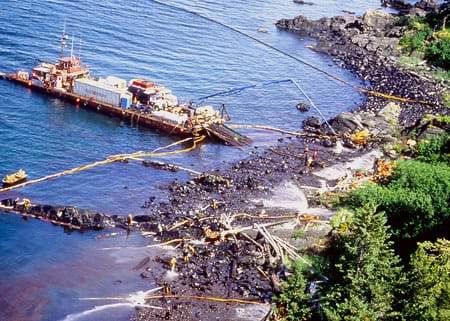
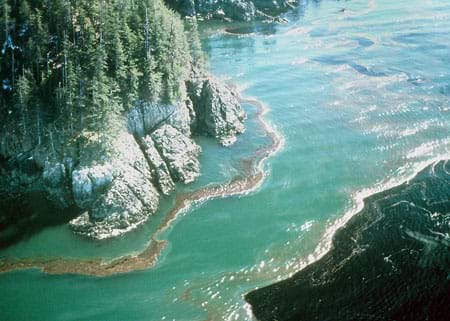
- Discuss both the environmental engineer and the oil visitor owner positions with regard to the price of cleanup. When is make clean really clean and when is expensive actually expensive? (For this activeness, owners desire the most constructive cleanup for a reasonable toll while environmental engineers desire the most effective cleanup regardless of cost.)
- Ask students to brainstorm different methods for cleaning upwardly an oil spill. Write their suggestions on the classroom board, reminding them that all suggestions are skillful and worth sharing. Accept them discuss if the suggested methods are really expert (effective) at cleaning up spills and how expensive they recall each idea might be.
- After brainstorming, discuss the methods that they will be using today to clean upward the oil spill: 1) skimming, because oil floats, 2) absorbing information technology onto pads that specifically absorb oil, and iii) adding a dispersant to break upward the oil "slick" surface into piddling droplets.
- Enquire them to form a hypothesis regarding which method they believe will be the best for cleanup and why and write information technology on their worksheets.
- Model setup: Accept student pairs prepare their oil spill pans. Have them place the pan on the table and put the stone in the middle of the pan. Add water to the pie pan until about half full. Tell students: In this model oil spill, the stone represents the land and the water represents the ocean. One objectives for your cleanup effort is to keep the oil away from the land.
- Begin testing: Have them place a small-scale corporeality (~ane tablespoon) of oil (dark-colored vegetable oil) in the pie pan. What happens? Have them lookout closely to come across if the oil moves toward the land.
- Take them place a plumage in the oily h2o. After xxx seconds or so, remove the feather and examine what the oil has done to it. What impact can they conclude that oil has on birds?
- Have them apply the skimmer (spoon) to try and remove the oil, pouring into a graduated cylinder. (Annotation: Demonstrate how to use the spoon to gently skim off the top layer of oil without removing spoonfuls of water). Inquire them to determine approximately what pct of oil and what percentage of water they removed? Record their measurment number on their worksheets. (Annotation: Obtain the number from the graduated cylinder since the oil and h2o will separate in the cylinder.)
- Have them identify a score (H = loftier, M = medium, L = low) on their worksheets for the cost and effectiveness of skimming if they were either the ecology engineer or the oil company owner.
- Next, have them use the absorbent cloth to absorb the oil. Ask them if they call up the cloth is expensive? How well did it work?
- On their worksheets, have them rate the cloth in terms of effectiveness (H, Thou, L) and price (high cost, medium cost, depression toll) if they were either the environmental engineer or the oil company owner.
- Lastly, have them identify ane or 2 drops of "dispersant" into the pie pan and stir it around with a spoon. Expect them to notice that the oil appears to break upwards into small droplets. Is this an effective means for cleanup?
- Have them use dispersant on the feathers to run into what result the oil now has on them. Look the feathers to be fine; the dispersant worked!
- Accept them rate the dispersant in terms of cost and effectiveness if they were either the environmental engineer or the oil company owner.
- Cleanup fourth dimension: Make clean the rocks with soap and water. Make clean upwards the surface areas with newspaper towels. Place the h2o, vegetable oil and dispersant from the pie pans and examination tubes downwardly the drain. Identify pie pans in garbage bags. Return whatever cleaned reusable supplies to a common expanse.
With the Students: 2d Class Period
- Students continue to complete the worksheets. Enquire them to brand two vertical bar charts on their worksheets showing the human relationship betwixt low, medium and high effectiveness (i of the bar charts) for each cleanup method and cost (the other bar chart) if they were an ecology engineer or an oil visitor owner. Refer to Figure 3 for an case of each.
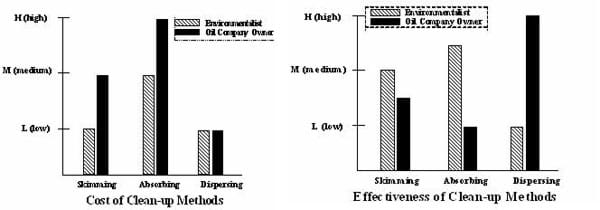
- Accept students discuss their answers with a partner. Allow them know that they demand to exist able to defend their answers.
- Take a Stand up!Enquire students to take a stand on the following statements. Have them line upwards in one of v rows based on whether they agree strongly, mildly, neutral (don't know if they agree or non), disagree mildly or disagree strongly with the following statements. (Note: Hang signs on the wall matching the possible responses, so students do not become confused as to which line is which.) Randomly telephone call on certain students to explain their point-of-view and logic.
- Have a Stand! "I call up in that location was a high caste of effectiveness and low cost in cleaning up the oil spill using skimming." Later they accept a stand (that is, form in rows), discuss the impact of the ocean waves and how this would make skimming that much more than hard to acquit out. Talk about how much h2o they picked up with their spoons and how constructive this method really was. Talk about the cost of boats that perform skimming procedures.
- Accept a Stand! "I think there was a high degree of effectiveness and low price in cleaning up the oil spill using absorbent cloth." While the cloth worked well, mention the environmental impact of cleaning up or disposing of the cloth. Accept they only added to the cleanup? This method may work squeamish in a pie pan, merely how effective is this method in an enormous sea oil spill? Besides, is this cloth expensive to buy?
- Accept a Stand! "I recall there was a high degree of effectiveness and low cost in cleaning upwards the oil spill using dispersants." Of import: Ask them where the oil went. Ask them if the water is really clean or non so clean? Point out the issues of putting more than chemicals in the water and if this is appropriate or non. Talk over with them the fact that the ocean waves might mix the dispersant. How might the dispersant touch animals and organisms in the water? Is the dispersant a pollutant that upsets the ecosystem balance?
- Collect the completed worksheets. And then, summarize the experiment. Be sure to talk about the diverse perspectives that were presented, based upon the environmental engineer or oil company owner point-of-views. Reflect on the bar charts equally one possible scenario, but explicate that different people would accept unlike answers.
Assessment
Pre-Activity Cess
Brainstorming: Enquire students to brainstorm different methods for cleaning up oil spills. Write their suggestions on the classroom board, reminding them that all suggestions are worth sharing during brainstorming. Have them discuss whether the suggested methods are really adept (effective) at cleaning up spills and how expensive they recall each idea might be.
Activity Embedded Assessment
Worksheet: Have students complete the Oil Spill Worksheet during the course of the activity. Verify that students are using the different materials to collect their "oil spill" by walking around the classroom and asking them which part of the procedure they are working on. Review their answers to gauge their mastery of the bailiwick.
Post-Action Assessment
Prediction Assay: Have students compare their initial predictions with their test results, as recorded on the Oil Spill Worksheet. Ask students to explain how effective each methods was. Analyze the data from each test to determine similarities and differences amidst each pattern solution. Place the best characteristics of each that can exist combined into a new solution.
Problem Solving: Accept students engage in open word to suggest solutions to the following problem:
- After trying to contain, make clean, dissolve, or remove the oil spill with the various utensils and "chemicals," you never reached a pristine environment. As environmental engineers, how would you approach the cleanup of a major or minor oil spill in a local water resource? Which, if whatever, of the cleanup technologies would y'all use? Would you employ more one?
Persuasion Paper/Oral Defence: In a short newspaper or oral defense, assign students to explicate the jobs environmental engineers perform, sources of pollution, and why pollution is harmful for the environment.
Making Sense: Accept students reflect near the science phenomena they explored and/or the science and technology skills they used by completing the Making Sense Assessment.
Troubleshooting Tips
This activity can exist very messy. Make sure to have plenty of paper towels for cleanup! All materials in this activity tin can be tending of in the garbage or downwards the drain.
Activeness Extensions
Cleaning Oily Feathers Experiment: In this experiment, students expect at the style oil affects bird feathers and endeavor out different cleanup methods to find out which works best. http://response.restoration.noaa.gov/preparation-and-education/educational activity-students-and-teachers/find-all-time-manner-clean-oil-bird-feathers.html
Graphing Changes in Marine Life Abundance Activeness: This study uses the same methods used by real marine biologists. http://oceanservice.noaa.gov/educational activity/stories/oilymess/working.html
Activity Scaling
For lower grades, focus on the bar graphs. Take the students present their graphs. If time permits, accept them add together pictures for back up.
For higher grades, add actress math support by having students create graphs that compare the effectiveness (y-axis) vs. cleanup method (x-centrality). Then accept them create another graph that compares effectiveness vs. costs of unlike cleanup methods. Take them explain/support their answers with a persuasive paragraph. Or, have pupil groups develop an action programme for an surface area of the coast where an oil tanker has had a major spill. What should the community do? Local regime do? Local engineers do? Have students utilize their graphs to support a proposal fabricated by the local government to the community.
References
"Exxon plans quick appeal in Valdez case: Estimate awards $four.5 billion in damages." Published Jan 29, 2004.Republic of colombia Daily Tribune. Accessed January 29, 2004.http://www.showmenews.com/2004/Jan/20040129Busi006.asp
Exxon Valdez Oil Spill Trustee Quango http://www.evostc.state.ak.united states/
FAQS and History. Part of Response and Restoration, National Bounding main Service, National Oceanic and Atmospheric Administration http://response.restoration.noaa.gov/faqs/history.html and http://response.restoration.noaa.gov/
Copyright
© 2004 by Regents of the University of ColoradoContributors
Sharon D. Perez-Suarez; Melissa Straten; Malinda Schaefer Zarske; Janet YowellSupporting Plan
Integrated Education and Learning Program, College of Engineering, University of Colorado BoulderAcknowledgements
The contents of this digital library curriculum were adult nether grants from the Fund for the Improvement of Postsecondary Education (FIPSE), U.S. Department of Didactics and National Science Foundation (GK-12 grant no. 0338326). Even so, these contents do non necessarily represent the policies of the Department of Education or National Science Foundation, and you should not presume endorsement by the federal government.
Last modified: February nineteen, 2022

Source: https://www.teachengineering.org/activities/view/cub_enveng_lesson01_activity1
Posted by: cuomofrapter69.blogspot.com
0 Response to "Is Dawn Best For Cleaning Oil Spills Science Fair Project"
Post a Comment